What a beautifully overwhelming morning it has been at my writing desk. I am completely overjoyed to share some wonderful news from the heart of Starflower Press: my newest book, Under the Starflower: A Book of Blessings, has officially become an Amazon Bestseller, climbing into the Top 15 in its categories!
When I first sat down to write this collection, my deepest hope was that these pages would serve as true “word medicine”. As a ceremonialist and celebrant, I know how heavy the room can feel when words fail us. I wanted to create a gentle sanctuary of prose; a steady friend, if you like, to hold you at the delicate thresholds of life, death, love, and loss. To see it resonate so deeply and so quickly with readers, celebrants, and ministers across the United Kingdom and beyond is a milestone that fills my heart with immense gratitude.
Words That Hold Us When We Need Them Most
The reviews flowing in from the celebrant community and individual readers have moved me to tears. To know that these verses are finding a home in crematorium chapels, woodland burials, and quiet spaces of personal grief is the greatest reward an author could ask for.
Independent Celebrant Catrina Young kindly shared that the book will be “an invaluable resource to help me find exactly the right word medicine for funeral ceremonies of every kind.”
Another deeply touching review from minister and celebrant Diane McLeish looked at the book through the personal lens of losing her own mother, writing: “At a time when so much felt broken, that was a beautiful truth to hold onto… Under the Starflower feels less like a book on a shelf and more like a compassionate presence beside you.”
A Treasury for All Ceremony Types
The heart of this book is to meet people exactly where they are, acknowledging the unique textures of a life lived. It has been incredibly moving to see fellow ceremony makers connect with the intentional structure of the writing: “The beautiful, poetic prose is a balm to soothe the soul, and gently provides a place to rest a while, for those who grieve… A thoughtful collection of verse to draw inspiration and comfort from, a blessing, in its truest sense.”— Debbie Wells, Celebrant
“Veronika has come to understand that a meaningful blessing needs to meet people where they are… Perhaps what I appreciate most is that these blessings do not try to take grief away. They offer words with which to sit beside it.”— Reverend Maughan, Community Celebrant
“End of life can be such a difficult time but there really is a blessing to connect to everyone’s heart in this book… A must for celebrants but also for anyone looking for an appropriate blessing.”— Amazon Reviewer
Whether you are an officiating professional looking for fresh, inclusive offerings that honour everything from ancestral wisdom and the turning of the seasons to specific crafts and occupations, or someone sitting quietly with a breaking heart, please know that this book was written for you. Thank you from the bottom of my heart to everyone who has purchased a copy, left a beautiful review, or shared the news. Your support has given these blessings wings.
Under the Starflower: A Book of Blessings; Word Medicine for Cremations, Traditional and Woodland Burials, Interments, and Grieving Hearts, is available on Amazon in both Kindle and paperback editions. If you would prefer a signed copy, you can order directly through Starflower Press.
Illustrations by artist and funeral celebrant Philippa Mulvany.
http://veronikarobinson.com.temp.link/wp-content/uploads/2026/07/k-mitch-hodge-l9a5p6LwA9Q-unsplash.jpg10801920Veronika Sophia Robinsonhttps://veronikarobinson.com/wp-content/uploads/2026/08/Updated-logo-colour_26-300x138.pngVeronika Sophia Robinson2026-08-29 15:52:412026-08-29 15:52:41Celebration of Words: Under the Starflower Becomes an Amazon Bestseller!
There is a quiet, shifting threshold that occurs just as Summer begins to hold its breath. You can smell it before you see it: the heavy, sweet-sharp scent of fermenting windfalls in the grass, the sudden drop in evening temperatures, and the way the shadows beneath the trees seem to lengthen, turning a deep indigo.
In the ordinary world, the calendar tells us it is nearly September. But in my heart, I know this time by its true, secret name: The Witch-Apple Moon.
It is under this Moon that the bright reds and greens of the orchard fade, and the apple skins deepen into a beautiful, glossy midnight. These are the little black apples. They are not ruined; they are transformed. They are the physical manifestation of patience: of weathering the frost, and finding your most potent self in the dark.
In the quiet hours, fuelled by the scent of woodsmoke and old paper, I have been working on word medicine born from this very alchemy. I’m pleased to say that it is finally ready to be shared with the world.
Introducing:
Little Black Apples
A Whimsical Witch’s Wisdom For Creating a Beautiful Life through Dark Storms and Wild Healing
My writing, throughout Little Black Apples, is accompanied by the light, joyous full-colour artwork of Laura Whalen. This book is a beautifully structured, cyclical journey of deep evolution. Grounded in powerful botanical metaphor, it mirrors the natural progression of a soul stepping fully into its power, seamlessly bridging psychology with high-vibrational Cosmic magic.
The journey unfolds through three sacred seasons:
The Bud:The season of inner knowing. Build your inner architecture through foundational root-truths that shift your internal mindset, heal old patterns, and claim your true identity.
The Blossom:The season of sensory opening. Awaken your physical body through sensory spell-threads, exploring the radical acts of somatic awareness.
The Fruit:The season of eternal magic. Step into high-vibrational spirituality, utilising sacred charms to unlock your gifts.
Once you have harvested your magic, you are invited to place your gifts into The Shared Basket, sharing your unique medicine with the world.
Little Black Apples officially releases on the upcoming New Moon this September: The Witch-Apple Moon.
So, as the New Moon awakens in the dark, I invite you to step into the orchard with me. Put on your heaviest coat, step out into the crisp evening air, and look up at the night sky. Let the warmth of the Sun go without a moment of regret. Together, we can welcome the introspective dark that follows.
Thank you for walking this path with me, for supporting independent publishing through Starflower Press, and for welcoming the dark that follows the Sun.
May you be wrapped, rooted, and protected by an inner love so deeply healing that nothing outside of you can ever shake your worth. Welcome to the season of the hidden star.
With warmth and orchard magic, Veronika Sophia Robinson Author & Founder of Starflower Press
http://veronikarobinson.com.temp.link/wp-content/uploads/2026/08/marko-blazevic-S7mAngnWV1A-unsplash.jpg10961920Veronika Sophia Robinsonhttps://veronikarobinson.com/wp-content/uploads/2026/08/Updated-logo-colour_26-300x138.pngVeronika Sophia Robinson2026-08-15 22:09:062026-08-15 22:14:14On The Way to the Witch-Apple Moon
I looked around the kitchen and immediately chose to go out to the porch and spend some time writing. Housework can wait, I told myself.
Outside, my porch offers the perfect sanctuary. As I sit with my laptop, I am surrounded by a vibrant, living canvas: bird baths bustling with activity, bees and butterflies dancing through the herbs, and the lush green of raspberry canes and blueberry bushes. Beyond them stand the cherry and apple trees under a brilliant blue sky, whilst my black cats lounge nearby, keeping me quiet company. It is a space designed for flow.
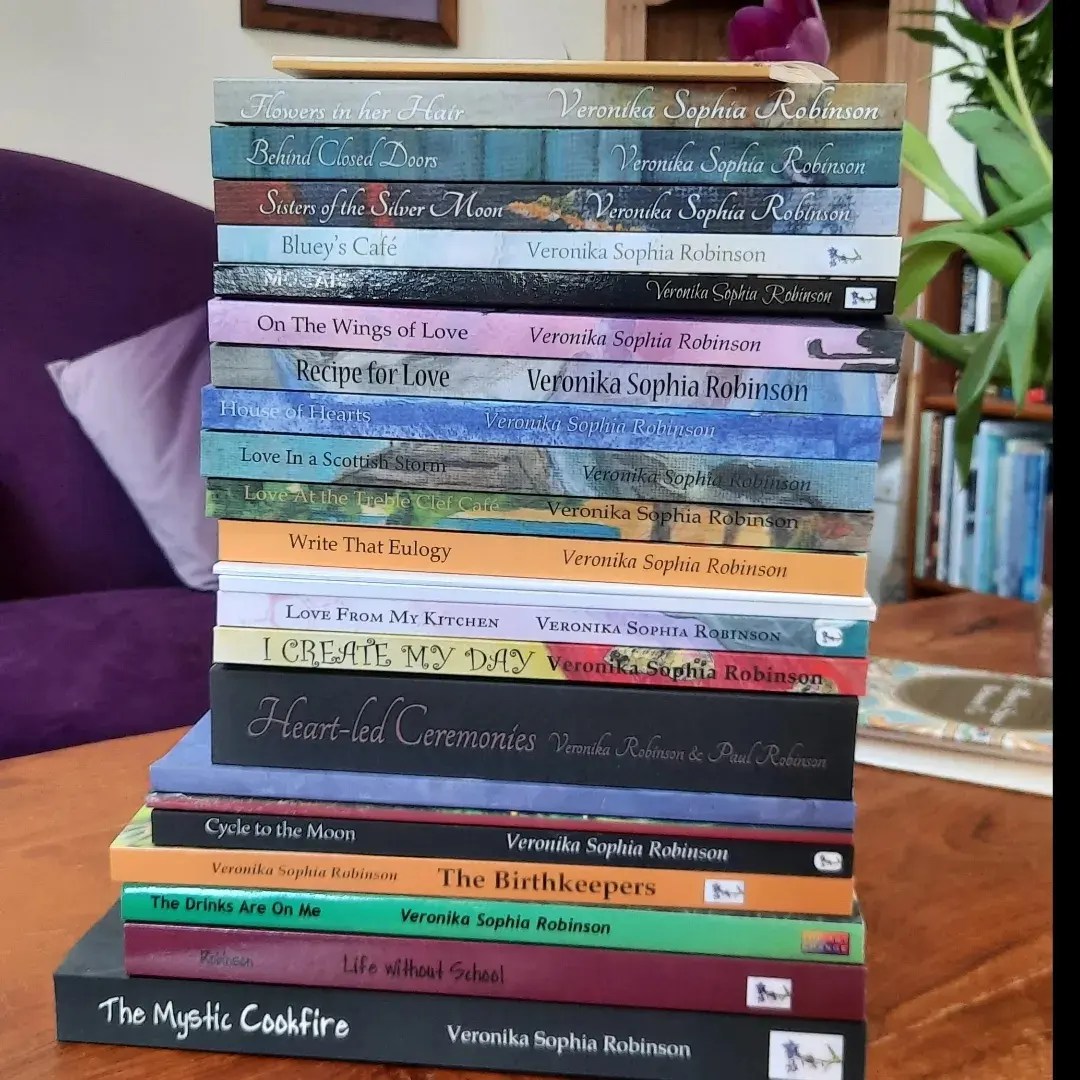
I thought of a dear friend whose home is immaculate. Her skirting boards are flawless; her windows gleam with a brilliance that suggests a personal pact with the Sun. Then, I reminded myself: she’s not a writer. My friend doesn’t have a chorus of ideas clamouring inside her head, demanding to be captured whilst the air is warm and the light is perfect. I didn’t get to write more than thirty books by doing housework. If my literary output relied on my enthusiasm for dusting, my bibliography would consist of a single, unfinished pamphlet. In fact, I don’t think I even own a duster! That tells you everything you need to know about me.
Thankfully, the dishes don’t actually pile up to the ceiling in our house, but that is zero credit to me. That is entirely down to Paul. Whilst I am sitting out here typing away at a brisk and joyful pace, Paul is actively handling the domestic tide including being a reliable resident barista. Paul is the unsung hero of my publishing journey, the guardian of the kitchen sink. Whenever he catches me eyeing a bottle of surface spray and the slight under-my-breath groan, he delivers his familiar, life-saving mantra: “Go and write. Leave the housework.” Trust me, my friends, this is advice every author needs to hear.
The temptation to let chores dictate our schedule is a constant hurdle for many. It is easy to fall into the trap of thinking we must clear the physical decks before we can permit ourselves to create. We trick ourselves into believing that a pristine environment is a mandatory prerequisite for sitting down to work. In reality, the domestic routine simply loves to steal our time and demands attention for the mundane whilst simultaneously keeping us away from our true calling. If I had waited for every room to be perfect before diving into my next project, those thirty-plus books would still be trapped inside my imagination. Instead, they are out in the world, bound and printed, because I learned the fine art of tactical blindness. Thank goodness, given there are at least another ten books in various states of process and progress.
I can look directly at a basket of laundry waiting to be folded or hung up in the wardrobe, acknowledge its existence, and calmly walk away to bring a new book to life. Creativity requires robust boundary-setting. To listen to the muse demands that we prioritise the permanent joy of writing over the temporary satisfaction of a vacuumed rug. The dust, after all, is patient. And dust, as it happens, always finds a way to settle again by the next morning. But a wave of inspiration is a gift for the present moment; if you ignore it to go and clean the bathroom tiles, you miss the joy of the flow.
So, to my fellow writers (or other creatives) drowning in domestic guilt: step away from the mop. If you are blessed with a Paul, thank them profusely and head straight for your writing desk or studio. If you aren’t, let the dust bunnies form a colony under the sofa for a few weeks. Your readers will never care if your house was spotless, but they will care deeply about the story you chose to tell. Turn your back on the cleaning, head out to your porch, and go write your book.
http://veronikarobinson.com.temp.link/wp-content/uploads/2026/06/Veronika-Sophia-Robinson.jpg7681366Veronika Sophia Robinsonhttps://veronikarobinson.com/wp-content/uploads/2026/08/Updated-logo-colour_26-300x138.pngVeronika Sophia Robinson2026-08-11 19:04:032026-08-11 19:09:48Books Don't Get Written By Doing Housework!
Veronika, after writing over 30 books, what was the specific moment or encounter that told you Under The Starflower: A Book of Blessings needed to be born into the world now?
Almost all of my book titles or book ideas come to me in an instant. I listen to the whispers to see where they lead. This book was no different. In some ways, it was a natural marriage of two ideas. The first idea: I sometimes write short, personalised rhymes to include as closing words after the committal. The second influence was based on all the times I’ve searched for a reading or a poem for a family, and nothing was quite right. There are some truly beautiful ones available, of course, and I love being able to suggest them to the bereaved. There are also many readings I’ve heard countless times in my years as a funeral celebrant. These are the ones families see first when they do an Internet search. There are some I remember hearing when I was 19 (and that was almost 40 years ago!)
I wanted to bring something fresh and beautiful; something from my heart. You could say that the moment of deciding to offer this book of blessings for funeral celebrants and grieving hearts rested on my desire to bring ‘a softening’ to this world.
You describe this book as “Word Medicine”. What does that phrase mean to you personally when working with a grieving family?
Words can wound, as we know, and they can heal. If we consider medicine an aid to the healing path, then “word medicine” is a way of supporting those in grief; a balm, if you like. One of the things I have learned as a funeral celebrant is to let those who are grieving speak without interruption. So, my practice is to refrain from sharing relatable stories. I imagine it to be like this: they have passed me a ball to hold (their grief is the ball). My job is to hold the ball. Not talk about my experience of a ball. So the word medicine I seek, and that comes to the page when writing a funeral script, actually begins in the client meeting. They then receive this balm through my spoken voice on the day of the ceremony.
The book features beautiful illustrations by Philippa Mulvany. How did your words and her visual art come together to create a sanctuary for those reading and listening to the words?
From the first time I saw Pippa’s art, I was enchanted. I have a few pieces in my home of her black and white line drawings (which I truly treasure). I am blessed to collaborate with some wonderful artists. Although I’d never collaborated with Pippa before (and nor had she previously illustrated a book), I kept seeing her sketches in my mind as I thought about the blessings. So, I asked, and she said yes! Definitely a collaboration made in heaven. Pippa read my verses and chose which ones to illustrate (she’d have happily illustrated every page!). Rather than direct her, as such, she created images based on how the verses ‘spoke’ to her. A bonus for this book is that Pippa is also a funeral celebrant, so she was able to draw on that experience and infuse it into her art.
Why did you choose the structure of “blessings” for this text, rather than a standard guide to officiating?
Because it’s not about officiating a complete ceremony. Under The Starflower is specifically about bringing moments of deep reflection through ‘distilling the essence of a feeling, thought or topic’ into a short verse/s. As I said earlier, I was so used to seeing the same poems and readings at funerals. I wanted to offer something different for celebrants and, of course, the grieving hearts who will hear these poems.
You wrote this book from your 300-year-old cottage close to the fells of Cumbria. How did the landscape of the Eden Valley hold you while you wrote about the heavy thresholds of loss?
The landscape of the Eden Valley holds me as a writer in the same way it has held me during my own sorrows: the deaths of my pre-term children, my father’s death in a car crash, the suicide of my best friend, and, more recently, my mother’s death.
Throughout my life, Nature has always been my first comforter. My earliest life memories include dancing underneath an electrical storm in my homeland of Australia, touching leaves, climbing trees, breathing the scent of petrichor, and eating dirt! Haha. I have a deep need to connect with Nature and Mother Earth every single day: from the moment the sunlight reaches through my bedroom window in the morning (or awakening to the sound of birdsong), walking barefoot on the grass within minutes of getting out of bed, caressing the apples on my trees, plucking blueberries off the bushes, walking in the woods, resting my cheek against the cool moss on old stone walls, and more. So much more. I can see the fells (Pennines) from my writing room. They are not only the backbone of England, they’re my touchstone. I often write while out under the porch, where I get a close-up view of bees, wasps, various butterflies, birds like the bullfinch, blackbird, great spotted woodpecker, song thrush, and ever-changing cloudscape.
Your core philosophy is that no one truly knows what an individual is feeling because every relationship is entirely unique. Why is dismantling the phrase “I know how you feel” so vital for genuine healing and connection?
How can anyone ever know how we feel? Sure, we may have experienced grief. We may have experienced the death of a loved one in the same type of ending: car crash, dementia, etc., but our feelings are our own. No one else in the world has walked our life’s path, and the sum total of our experiences. They don’t have our wiring. And then, there’s the relationship we had with the person who died. That relationship is, like our feelings, experiences and wiring, ours and ours alone. For example, my experience of being mothered is going to be different to everyone else on this planet (including my seven siblings). I can’t know how someone else feels about their mother’s death. I can only know my own feelings.
For me, “I know how you feel” is right up there with other irritating expressions, such as: “I’m so sorry for your loss”. The person who died isn’t lost. They’re dead. Yes, of course there is a loss (a missing loved one) in their life. I understand that. I just think it is a cliché (an easy way out, with little thought, and not really an empathic way of connecting). Why don’t we slow down and think of another way of validating their life-changing pain?
I believe we need to dismantle the phrase of “I know how you feel” (and toss it away) because it short-circuits and completely invalidates how the mourner is feeling. The way I see it is that as soon as someone says that phrase they are putting the attention onto themselves, and their experience, rather than leaving it with the person who has just been bereaved. I appreciate that people think the phrase creates connection. I don’t believe it does.
I remember the day my mother died (on the other side of the world to me), I could barely think and function. I had to go to the supermarket that day as I was, ironically, hosting a retreat for funeral celebrants that afternoon on the topic: Creating Beautiful Bereavement Ceremonies. I bumped into someone I know (and who had been told a few days before, by my husband, that my mother was dying). When they asked how my mother was, I replied that she’d died that morning. “I know how you feel!” they said, and spent the next twenty minutes going through their old grief story with not another word to acknowledge my feelings.
Many mourners have similar experiences.
The best support we can give to the bereaved is to listen. That is, do not try to fix them (as much as we want to wave a wand!) or change the subject. Very few people know how to just ‘be’. To hold ‘the ball’. One of the kindest things you can offer to someone who is grieving is to ask them to tell you about their loved one.
You advocate for gentleness with grieving hearts. What does real, practical gentleness look like in a society that often rushes people through loss?
We live in a society that rushes through everything, so of course, culturally, we’re not going to make allowances for heart-wrenching pain. We would, however, give people time off to heal a broken leg! A grieving heart, though? Not likely.
For me, it is about being aware EVERY SINGLE DAY that anyone I may encounter could be carrying a grieving heart: the person by the till at the service station, the lady in front of me in a supermarket, the old man sitting on a park bench, the young woman avoiding eye contact as she walks down the street, call-centre woman, the person next to you on the train, the person you think is driving too slowly or hasn’t moved when the lights turned green.
Grieving hearts
are
everywhere.
When we start to see the world full of ‘the walking wounded’, our words become softer, our time becomes a gift, and our kindness is a given.
There was a time when those in mourning wore black. And, of course, many of us do at funerals (and just as many don’t, if they want a non-traditional vibe). Black is worn as an everyday item, so we don’t have the same instant visual identifier as we had in the past. There’s a lot of attention in the lead-up to the funeral and the day of the service, but then everyone else goes back to their busy lives. Suddenly, the bereaved are living in an uncharted liminal space.
Here, but not here.
Their heart has been shredded, and the world is just carrying on as if nothing’s happened. Somehow, that makes the pain even worse.
My experience of grief was that I soon learned people are fundamentally focused on self. I’ve learned, the hard way, that when I face a bereavement, the kindest thing I can do for myself is to go into isolation. This saves people from saying the usual stupid things, and means I don’t have to deal with any more upset than I’m already going through. I can count on five fingers the people who were genuinely there for me (even if not near me physically) when my mother died.
When working with the bereaved, I always check to see what support they’ve got around them. Not everyone has a strong circle of family or friendships. There may be family members around, but they are constantly trying to ‘shut down’ the chief mourner with comments like “it is what it is” or “she’s in a better place” or “we have to get on with things”. I’ve heard people, whose spouse of sixty years has died, say “I really miss her” and their next of kin replying with: “Don’t be silly Dad!” How is it silly to feel the ache of emptiness?
The book covers cremations, traditional and woodland burials, and interments. How does the physical setting change the texture of the words needed?
It changes everything. A chapel, no matter how beautiful, is an indoor space. It disconnects us from the outside world (unless it is beautifully designed, like the one at Roucan Loch, near Dumfries, Scotland where you’re comforted by views of the loch).
It is a legal requirement to ‘dispose’ of a body. We are disconnected from that at a crematorium. We use curtains (in some places and cases) to mark the final goodbye. Increasingly, people are shunning the shutting of a curtain.
When we are in Nature for a burial, an interment or a scattering, we can draw on the beauty of the world around us. We are also connected to the physicality of the final goodbye. This helps the brain to connect with the reality of the ending. As much as it is confronting, it enables the slow path of healing to begin.
For me, as a woman and as a celebrant, I’m most at home in Nature. Standing under a canopy of trees in Summer or frosty grass in the depths of Winter, brings a level of healing that’s easier to tap into than when you’re indoors. There are many verses in Under The Starflower which draw on Nature and anchor mourners to the setting. There are also verses suited to the crematorium.
Grief isn’t just about the immediate shock of death; it is, in your own words, “a long, quiet road”. How does Under The Starflower support a heart six months or a year after the funeral is over?
There is permission in the book for celebrants and families to publish their chosen verse within an Order of Service booklet (provided copyright and credits are included). I know that families hold onto these booklets for the rest of their lives. They are keepsakes. Those words will take them back to the day of the ceremony, and will act as a balm in the same way that my funeral scripts bring comfort years and years after the ceremony.
Relationships are rarely perfect. How can a blessing honour a loss where the relationship was complicated, strained, or painful?
Honesty is an important aspect of healing. In the blessing about an estranged child, titled, The Unbroken Thread, it acknowledges the “unsaid words and burned bridges” while declaring that it “doesn’t match the love which remains”. The reading gives permission, if you like, to release “the heavy stones we used to hold”, and claims “the tenderness which remains”.
A blessing can also remind us of the strengths or qualities of the person who has died, and this, too, may bring healing.